

At the beginning of my career, SaaS didn't exist. Tech companies built everything they needed in-house. Even small businesses had their own homemade timesheets, CRM systems, and even ERP solutions. That's how "legacy software" came to be. Most of it was terrible—hastily cobbled together by summer interns without much enthusiasm—and everyone constantly complained.
Then came SaaS. Just as there's now an app for everything, there's a SaaS solution for every business function.
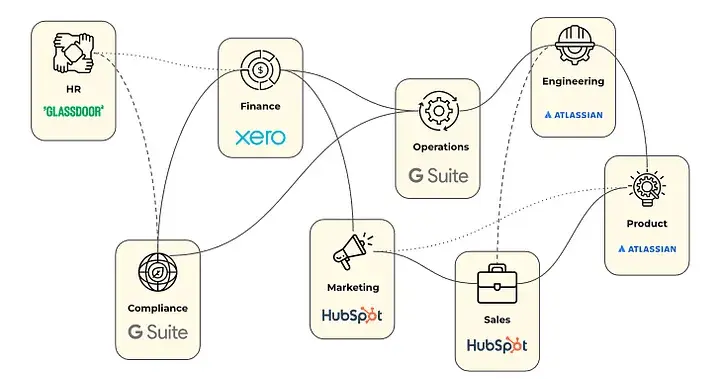
What is SaaS? In short, SaaS is a cloud-based software delivery model that provides access to applications via subscription.
Today, a startup's core operating system is a web of multiple SaaS tools. And as any founder will confirm, the bills pile up quickly. I'm certain your business uses SaaS tools your CFO hasn't even heard of. You do have a CFO, right? Really?!
The worst part is that these companies have grown so rich on their gross margins that they've stopped innovating. I've used JIRA for most of my career, and it looks virtually identical to how it did at the beginning. The only thing they've done is move this outdated software to the cloud ten years ago. Maybe they rounded the buttons slightly. Just slightly.
This has gone so far that we now need SaaS to manage your SaaS subscriptions. And this isn't a joke.

AI-Powered Operating System
Often, SaaS tools address small tactical gaps where implementing full-scale solutions like Salesforce, Hubspot, or even Shopify would be overkill. At our agency, we actively use artificial intelligence to create such tailored solutions.
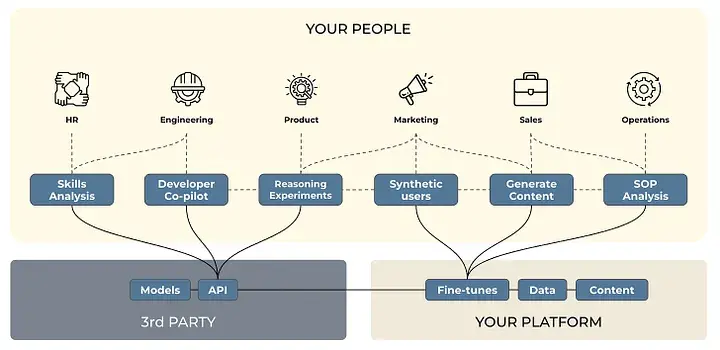
The end result might look like this: We build industry-specific functionality tailored to a client's needs and deploy it as lightweight web apps or microservices. Where building from scratch isn't practical, we leverage APIs like Stripe.
When needed, we develop dedicated user interfaces and then combine them into larger systems, integrating areas like sales and marketing. Essentially, this resembles Hubspot's functionality.
The core of such agency-built software is artificial intelligence and large language models (LLMs). In many cases, workflows can be fully automated, eliminating the need for user interfaces altogether, with AI autonomously executing tasks via API sequences.
Want proof this is possible today? Here's an example: Our intern built an AI-powered invoice processing system that saved $8K on a SaaS purchase. It took just 4 hours.

What About More Complex Software?
Building software for startups is often simpler because early-stage needs focus on specific tasks. As products and operations grow more complex, these requirements expand. The startup prospers and scales, eventually becoming a corporation.
Corporations prioritize security and regulatory compliance. Software vendors assume this responsibility—or at least claim to. This creates risk delegation: if something goes wrong, you can point fingers at the vendor while keeping your bonuses intact.
Simultaneously, a secondary trend emerges: AI is also boosting developer productivity. Some report single-digit percentage gains, others claim 200% improvements.
To illustrate, we ran simple calculations estimating how AI-driven productivity gains might reduce software development costs. We accounted for baseline assumptions like economic growth and inflation (which typically increase prices), low price elasticity due to growing demand, and gradual attrition of developers choosing careers less susceptible to AI displacement.
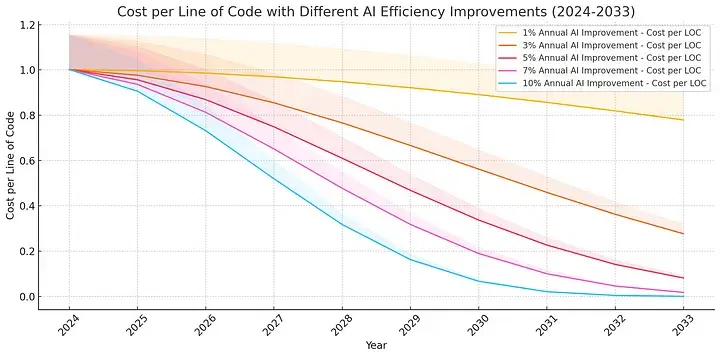
Despite these factors, coding costs will decline as AI assumes this work. They may become so marginal that coding loses significance altogether. This is a conservative model, considering only incremental efficiency gains.
When AI agents achieve industrial-scale software production capabilities, development costs will plummet linearly.
Not All SaaS Is Created Equal
Code is getting cheaper. Who survives? Who disappears? Who decides?
Companies exclusively building SaaS businesses—where the software itself is the product—face the greatest risk. Obviously, most firms won't build their own Photoshop—that's usually overkill.
However, building custom CRMs wasn't uncommon pre-SaaS. This may become feasible again. Technical platforms like Datadog are vulnerable. Many startups use it because it seems sensible, but ultimately waste money logging unnecessary debug data—something LLMs could handle.
Still, these companies won't surrender without a fight. Many are already bolting on AI integrations. But corporations struggle to adapt to new eras—in this case, the AI-native era. The innovator's dilemma will compel them to milk their SaaS models until it's too late to catch up. Competition won't come from new startups, but from existing customers simply churning.
So in a world where code becomes cheap and AI takes over, one question remains: Who's next? Maybe your favorite SaaS. But don't worry—while you read this, our new AI agent is already building its replacement. Or trying to.
To accelerate your business growth and significantly enhance operations, start by integrating cutting-edge AI solutions from NeuroPlume. This empowers your team to focus on priorities while boosting overall productivity. Our AI models integrate seamlessly with existing systems, ensuring business flexibility and scalability.